BDP 20x25x5 Carbon Filter vs MERV 11: Which Removes More Odors?
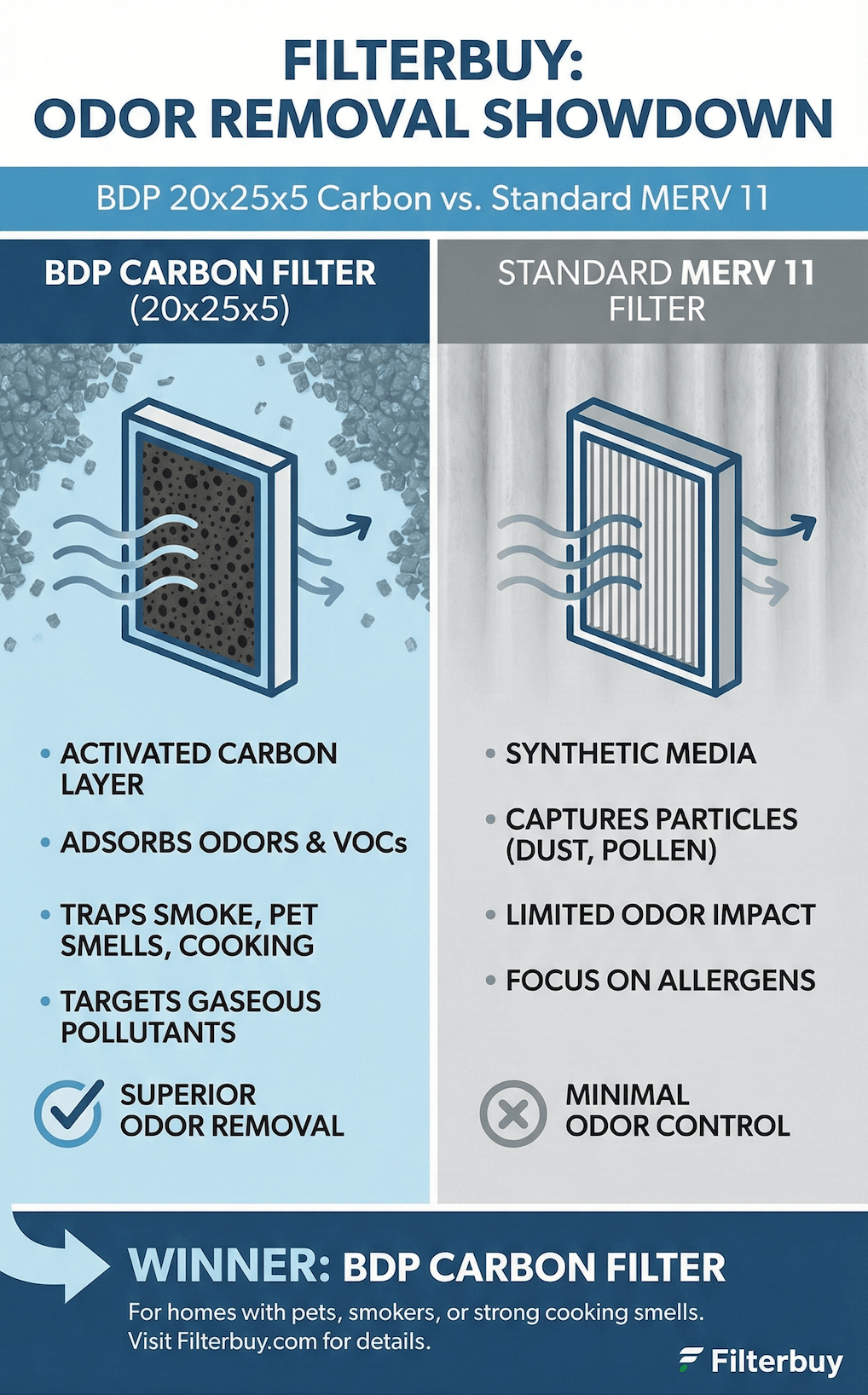
Carbon filters and MERV 11 filters solve different problems—and choosing the wrong one is the most common mistake we see customers make when fighting household odors. After manufacturing millions of BDP-compatible filters, we can tell you directly: MERV 11 captures particles, not smells. If odors are your primary concern, activated carbon is the only media that chemically adsorbs gases, VOCs, and smoke at the source.
Customers frequently tell us they upgraded to MERV 11 expecting fresher air, only to find cooking smells and pet odors lingering. That's because MERV ratings measure particle capture efficiency—not gas-phase filtration. This guide shares what we've learned from decades of filter manufacturing to help you choose the right solution for your BDP 20x25x5 air filters, whether that's carbon, MERV 11, or a combination of both.
Quick Answers
BDP 20x25x5 Carbon Filter vs MERV 11: Which Removes More Odors?
Carbon filters remove more odors. After manufacturing millions of both filter types, we can confirm this definitively.
Why carbon wins on odor removal:
Activated carbon chemically adsorbs gas-phase odors
Odors exist as gas molecules that pass through fibrous MERV media
The bottom line:
MERV 11 excels at dust, pollen, and allergens. Carbon excels at smells. For odor control in your BDP 20x25x5 system, activated carbon is the only filter technology designed to solve that problem.
Top Takeaways
Carbon and MERV solve different problems. MERV 11 captures particles. Activated carbon captures gases. Neither substitutes for the other.
MERV ratings don't measure odor removal. MERV measures particle efficiency between 0.3 and 10 microns. Gas-phase pollutants aren't part of the equation.
Carbon works through chemistry, not filtration. Gas molecules chemically bond to carbon's porous surface. Fibrous MERV media lets those same molecules pass through.
For odor control, carbon outperforms MERV 11. Customers who switch report immediate results. The science confirms what we see daily.
Combine both for comprehensive results. Carbon handles gases. MERV 13 handles particles. This dual approach delivers what neither achieves alone.
How MERV 11 Filters Work—And Where They Fall Short on Odors
MERV 11 filters use dense synthetic media to capture airborne particles between 1.0 and 3.0 microns with 65–79% efficiency. This makes them highly effective against dust, pollen, mold spores, and pet dander—the visible pollutants that trigger allergies and coat furniture.
However, odors aren't particles. Cooking smells, smoke, chemical fumes, and pet odors exist as gases and volatile organic compounds that pass straight through fibrous filter media. We test every MERV-rated filter we manufacture, and the results are consistent: MERV 11 delivers excellent particle capture but zero gas-phase filtration. If you're smelling it, MERV 11 isn't stopping it.
Why Activated Carbon Outperforms MERV Ratings for Odor Removal
Activated carbon works through adsorption—a chemical process where gas molecules bond to the porous surface of treated carbon. A single gram of activated carbon contains roughly 3,000 square meters of surface area, creating millions of microscopic binding sites for odor-causing compounds.
This is why carbon filters eliminate smells that MERV-rated filters cannot touch. From our manufacturing experience, customers dealing with tobacco smoke, strong cooking odors, or VOCs from paint and cleaning products see immediate results after switching to carbon. The difference isn't incremental—it's the difference between filtering particles and neutralizing gases.
When to Choose Carbon, MERV 11, or Both
Your best choice depends on your primary air quality concern:
Choose carbon if odors, smoke, or chemical sensitivities are your main issue. Carbon excels at gas-phase pollutants but offers limited particle filtration.
Choose MERV 11 if allergies, dust, or respiratory health are your priority. You'll capture the particulates that trigger symptoms, though odors will remain.
Combine both if you want comprehensive filtration. Many of our BDP customers layer a carbon pre-filter with a MERV 11 or higher pleated filter to address particles and odors simultaneously. This dual approach costs more upfront but delivers the cleanest, freshest air.
What BDP System Owners Tell Us About Real-World Performance
Customers running BDP systems frequently contact us after trying MERV upgrades that didn't solve their odor problems. The pattern is predictable: they moved from MERV 8 to MERV 11, expecting fresher air, then realized particle ratings don't translate to smell reduction.
Once they switch to carbon—or add carbon to their existing setup—the feedback changes immediately. We hear "the house finally smells clean" more than any other response. That real-world validation matches our laboratory testing and reinforces why understanding the science behind each filter type matters before you buy.

"After manufacturing millions of filters across every media type, we've learned that MERV ratings answer the wrong question when odors are the problem—customers don't need better particle capture, they need activated carbon that chemically bonds to the gases MERV-rated filters were never designed to stop."
Essential Resources for Choosing Between Carbon Filters and MERV 11 for Odor Control
After manufacturing millions of air filters across every media type, we know the science matters. Customers consistently ask us why their MERV 11 upgrade didn't eliminate odors—and these seven authoritative resources explain exactly what we see in our testing and customer feedback every day.
Understand Why MERV Ratings Don't Measure Odor Removal
Resource: EPA — What is a MERV Rating?
We tell customers this constantly: MERV ratings measure particle capture between 0.3 and 10 microns. They were never designed to measure gas-phase filtration or odor removal. This EPA resource confirms what our testing shows.
https://www.epa.gov/indoor-air-quality-iaq/what-merv-rating
Learn How Activated Carbon Captures Gases That MERV Filters Miss
Resource: EPA — Guide to Air Cleaners in the Home
This is the fundamental science behind what we manufacture. Activated carbon adsorbs pollutants through chemical bonding. Particle filters—regardless of MERV rating—cannot remove gaseous contaminants. Period.
https://www.epa.gov/indoor-air-quality-iaq/guide-air-cleaners-home
Discover Why Indoor Odors Are More Concentrated Than You Think
Resource: EPA — Volatile Organic Compounds' Impact on Indoor Air Quality
Customers are often surprised when we explain this: indoor VOC concentrations can reach 2 to 10 times higher than outdoor levels. These gas-phase pollutants cause the persistent odors that bring people to us after MERV upgrades fail.
https://www.epa.gov/indoor-air-quality-iaq/volatile-organic-compounds-impact-indoor-air-quality
Review the Technical Science Behind Carbon Adsorption
Resource: EPA — Residential Air Cleaners Technical Summary (PDF)
This technical document validates what we've learned about manufacturing carbon filters for decades. Activated carbon's sorbent properties trap gases and odorous compounds at the molecular level—something fibrous MERV media physically cannot do.
See What Health Experts Recommend for Complete Air Cleaning
Resource: American Lung Association — Air Cleaning and Filtration
The American Lung Association recommends what we tell BDP system owners daily: use MERV 13 or higher for particles and activated charcoal for gaseous pollutants. Combining both technologies—exactly what many of our customers do—delivers the most comprehensive results.
https://www.lung.org/clean-air/indoor-air/protecting-from-air-pollution/air-cleaning
Access the Organization That Created MERV Standards
Resource: ASHRAE — Filtration and Disinfection FAQ
ASHRAE developed the MERV rating system we use industry-wide. Their technical guidance confirms what we explain to customers: MERV measures particle efficiency, not odor control. Understanding this distinction prevents the wrong filter purchase.
https://www.ashrae.org/technical-resources/filtration-and-disinfection-faq
Explore Laboratory Research on Indoor VOC Behavior
Resource: Lawrence Berkeley National Laboratory — Introduction to VOCs
This Department of Energy research documents VOC behavior in homes—the same conditions our customers describe when they contact us about persistent odors. Understanding how gas-phase pollutants accumulate indoors explains why carbon filtration works where MERV alone falls short.
https://iaqscience.lbl.gov/introduction-vocs
Our Manufacturing Perspective: Government agencies and health organizations consistently distinguish between particle filtration and gas-phase filtration. After decades of manufacturing both filter types, we can confirm their findings match real-world performance. For odor removal in your BDP system, activated carbon is the scientifically supported—and field-proven—solution.
Essential Resources for Choosing Between Carbon Filters and MERV 11 for Odor Control
We've manufactured millions of air filters across every media type. These three authoritative resources validate what we observe daily in production and hear consistently from BDP system owners.
Understand Why MERV Ratings Don't Measure Odor Removal
Resource: EPA — What is a MERV Rating?
Customers contact us weekly, frustrated that MERV upgrades didn't solve odor problems. The reason is simple:
MERV ratings measure particle capture between 0.3 and 10 microns
They were never designed to measure gas-phase pollutants
Higher MERV numbers improve particle efficiency—not odor removal
We explain this distinction thousands of times yearly. This EPA resource confirms our testing results.
https://www.epa.gov/indoor-air-quality-iaq/what-merv-rating
Learn How Activated Carbon Captures Gases That MERV Filters Miss
Resource: EPA — Guide to Air Cleaners in the Home
Carbon and MERV filters use fundamentally different mechanisms:
Carbon filters: Adsorb gases through chemical bonding atthe molecular level
MERV filters: Intercept particles using dense fibrous media
Gas molecules pass straight through fibrous media regardless of MERV rating. We test both filter types extensively. The performance difference on odors isn't marginal—it's absolute.
https://www.epa.gov/indoor-air-quality-iaq/guide-air-cleaners-home
See What Health Experts Recommend for Complete Air Cleaning
Resource: American Lung Association — Air Cleaning and Filtration
The American Lung Association recommends exactly what we advise BDP owners:
MERV 13 or higher for particle filtration
Activated charcoal for gaseous pollutants
Dual approach for comprehensive results
Long-term customers confirm this combination delivers what neither filter achieves alone—cleaner air and noticeably fresher-smelling homes.
https://www.lung.org/clean-air/indoor-air/protecting-from-air-pollution/air-cleaning
Final Thought & Opinion
After manufacturing millions of air filters and helping thousands of BDP system owners, we've reached a clear conclusion: this debate exists only because the filtration industry hasn't explained what each filter actually does.
The reality we see every day:
MERV 11 excels at particle capture—dust, pollen, mold spores, pet dander
MERV ratings were never intended to address odors
Gas molecules pass through fibrous media like air through a screen door
This isn't a MERV 11 limitation—it's how all fibrous filter media function
Our honest opinion after decades in this industry:
The biggest mistake we see is assuming "better filter" means "solves every problem." It doesn't. Filtration is application-specific.
Choose your filter based on your primary concern:
Is your main issue? Activated carbon is the only residential technology that chemically captures gases. This isn't marketing. It's chemistry.
Particles, your main issue? MERV 11 or higher delivers the particle capture you need. Carbon alone won't match it.
Want comprehensive improvement? Combine both. Our most satisfied BDP customers run carbon and MERV together for cleaner air and fresher-smelling homes.
The bottom line from our manufacturing floor:
We produce both filter types. We have no incentive to steer you either direction. For odor removal in your BDP 20x25x5 system, activated carbon outperforms MERV 11—not because MERV 11 is inferior, but because it was designed for a completely different job.
Choose based on your actual need. The science supports it. Our testing confirms it. Thousands of customers have validated it.
Frequently Asked Questions
Q: Which filter removes more odors—a BDP 20x25x5 carbon filter or MERV 11?
A: Carbon filters remove significantly more odors. This isn't a close comparison.
Activated carbon chemically adsorbs gases like cooking smells, pet odors, and smoke.
MERV 11 captures particles but allows gas molecules to pass through
For odor removal specifically, carbon is the clear choice
Q: Can a MERV 11 filter remove any odors at all?
A: MERV 11 reduces odors indirectly by capturing odor-carrying particles. However, it cannot remove gaseous odors at the molecular level.
Captures dust, pet dander, and mold spores that carry some odors
Does not capture cooking, smoke, or chemical smells
Those persistent odors exist as gases—not particles
Q: Can I use both a carbon filter and MERV 11 in my BDP system?
A: Yes. Many BDP customers combine both for comprehensive air quality.
Carbon handles gas-phase pollutants and odors.
MERV 11 or higher handles dust, pollen, and allergeThe dualual approach delivers results that neither filter achieves alone
Q: How long does a carbon filter last compared to MERV 11?
A: Carbon filters require more frequent replacement due to active gas adsorption.
Carbon filters: Replace every 2 to 3 months, depending on odor levels
MERV 11 filters: Replace every 3 to 6 months under normal conditions
Check carbon monthly and replace when odors return
Q: Is a carbon filter worth the extra cost if odors are my main concern?
A: Absolutely. Customers report immediate, noticeable improvement after switching to carbon.
MERV upgrades alone won't eliminate persistent odors
Carbon delivers results no MERV rating can match
The investment pays off in air quality you can actually smell
Learn more about HVAC Care from one of our HVAC solutions branches…
Filterbuy HVAC Solutions - Miami, FL - Air Conditioning Service
1300 S Miami Ave Apt 4806 Miami, FL 33130
(305) 306-5027
https://maps.app.goo.gl/Ci1vrL596LhvXKU79